
Ergonomists and occupational health managers who rely on RULA, REBA, or OWAS to assess musculoskeletal disorder risk already know the core limitation of these tools: they produce categorical scores derived from visual observation, not continuous objective data. An EMG sensor changes the terms of the problem entirely — it measures what the neuromuscular system is actually doing during a task, not what it appears to be doing from the outside. The gap between laboratory-grade measurement and field-deployable ergonomic assessment is narrower than it looks. A peer-reviewed study published in Sensors (Hubaut et al., 2022) provides the validation data.
Why Observational Tools Like RULA and REBA Are Not Enough for Accurate MSD Risk Assessment
An EMG sensor captures the electrical activity of contracting muscle tissue in real time — a signal that observational methods can only approximate through posture classification. Tools like RULA, REBA, and OWAS are widespread because they are practical: a trained assessor, a checklist, a video recording, and the barrier to entry is low. But the output is fundamentally categorical. A posture is scored as acceptable, marginal, or unacceptable based on visual approximation of joint angles and perceived effort. There is no continuous signal. There is no muscle activation data. There is no way to distinguish between two workers performing the same task with radically different neuromuscular recruitment strategies — one compensating with lumbar extensors, the other distributing load across the posterior chain.
For workplace ergonomics to produce decisions that hold up under scientific and legal scrutiny — product design validation, equipment procurement, litigation support, return-to-work protocols — the methodology needs to close that gap. The question is how to do it outside a laboratory, in environments where space is constrained, surfaces are uncontrolled, and the task itself cannot be artificially simplified.
Field-Validated EMG and IMU Setup for Industrial MSD Risk Assessment: The Manhole Study
A 2022 study published in Sensors by Hubaut, Guichard, Greenfield, and Blandeau addresses exactly this problem. The research team set out to validate a fully embedded measurement setup — combining inertial measurement unit (IMU) sensors, Vicon motion capture, and Cometa surface EMG — for the assessment of MSD risk during manhole cover handling. For a broader overview of how EMG and motion capture integration works in biomechanical analysis, see our dedicated article. The task was reproduced under realistic operational conditions: subjects performed actual lifting techniques on loads of 20 and 30 kg, replicating the biomechanical demands of real sanitation and utility work.
The choice of manhole cover handling as the test scenario is deliberate. It involves high spinal loading, asymmetrical postures, and significant upper limb and trunk muscle recruitment — all risk factors for WMSD in utility and infrastructure workers. Three distinct lifting techniques were compared, each representing a different worker behavior profile.
The key validation question was whether the embedded IMU sensors produced kinematic data reliable enough to replace the gold standard of optical motion capture in field conditions. The results are unambiguous: IMU agreement with Vicon showed a mean bias below one degree across the measured joints, with limits of agreement ranging from -4.4° to 3.6°. For applied ergonomics — where the operational threshold between a safe and hazardous joint angle is typically measured in ranges of ten degrees or more — this level of accuracy is more than sufficient. It is publishable.
What Surface EMG Signals Reveal That Kinematics Cannot: Muscle Activation in Occupational Tasks
Kinematics alone describe how the body moves. EMG signals describe what the muscular system is doing to produce that movement — and at what cost. This distinction is the core argument for integrating an EMG sensor into any serious ergonomic assessment protocol. The role of EMG in ergonomics extends precisely because it captures the internal exposure — the neuromuscular response — that external observation cannot reach.
The Cometa Wave sensors in the study recorded activation from four muscles of the upper limb and trunk: deltoideus pars clavicularis, deltoideus pars scapularis, latissimus dorsi, and erector spinae. The resulting activation profiles correlated with subjects’ perceived effort ratings, confirming that the objective neuromuscular signal tracked subjective exertion in a physiologically coherent way. More importantly, the EMG data revealed activation patterns that kinematic data cannot capture: the relative contribution of different muscle groups, the timing of onset and offset, and the accumulation of fatigue indicators across repeated task cycles.
This is the measurement layer that observational tools cannot reach. A postural checklist can flag that a worker is bending beyond a threshold angle. It cannot tell you which muscles are absorbing that load, whether they are operating near their fatigue limit, or whether a different technique would redistribute recruitment more safely.
From Research to the Shop Floor: Deploying a Wireless EMG Sensor System for Ergonomic Risk Assessment
The methodological contribution of Hubaut et al. extends beyond any single study. What the paper validates is a blueprint: a fully wireless EMG sensor system, IMU-anchored and field-deployable, that produces data of sufficient quality for peer-reviewed publication and generates the kind of multi-modal evidence base that ergonomic interventions require.
For ergonomists and occupational health managers, this means the transition from observational to objective assessment is no longer a question of laboratory feasibility. It is a question of deployment. The instrumentation exists. The validation exists. What remains is integrating this approach into standard risk assessment workflows — and building the internal expertise to interpret and act on the data it produces.
For product engineers and industrial designers, the implications are equally direct. MSD risk assessment grounded in synchronized wireless EMG and kinematic data produces a level of evidence that supports design decisions with a specificity that observational methods cannot match. When a product modification is intended to reduce neuromuscular load on a specific muscle group during a specific phase of a specific task, only objective measurement can confirm that it actually does.
Reducing Setup Complexity: When EMG and IMU Are in the Same Sensor
The methodological architecture of the Hubaut et al. study — EMG signals correlated with kinematic and inertial data to characterise neuromuscular load across different lifting techniques — is scientifically sound and field-deployable. What the paper also illustrates, implicitly, is the instrumentation cost of that architecture when built from separate systems: an IMU rig, an optoelectronic reference, and a surface EMG system, each with its own acquisition pipeline and attachment protocol.
For routine deployment in occupational health programmes — where assessment needs to be repeatable across sites, operators, and task conditions — the complexity of a multi-system setup is a real constraint.
The logical evolution of this methodology is the progressive consolidation of the sensor layer. When EMG and IMU are integrated into the same wireless sensor, the synchronisation between muscle activation and segment kinematics is structural rather than procedural. Placement is reduced to a single attachment point per muscle site. The acquisition pipeline collapses from three systems to one. And the resulting dataset — EMG signals, onset timing, and inertial data from the same point of measurement — retains the analytical richness that makes this approach scientifically meaningful.
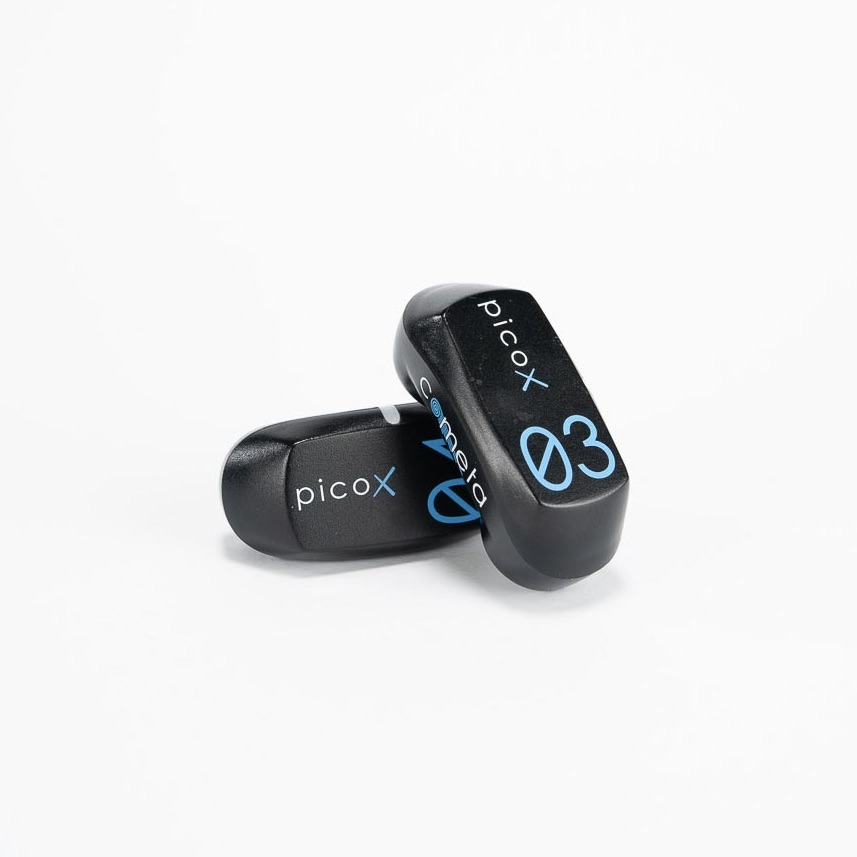
PicoX is built on this logic. For labs that maintain Vicon infrastructure, EMG and Motion Tools integrates natively with the optoelectronic pipeline; for those working with other motion capture systems, the SDK enables the same integration architecture with any third-party platform.
The methodology validated in this study is not confined to the research groups that published it. It is a deployable standard — if the instrumentation supports it.
Do you want to know more about our EMG systems?


